

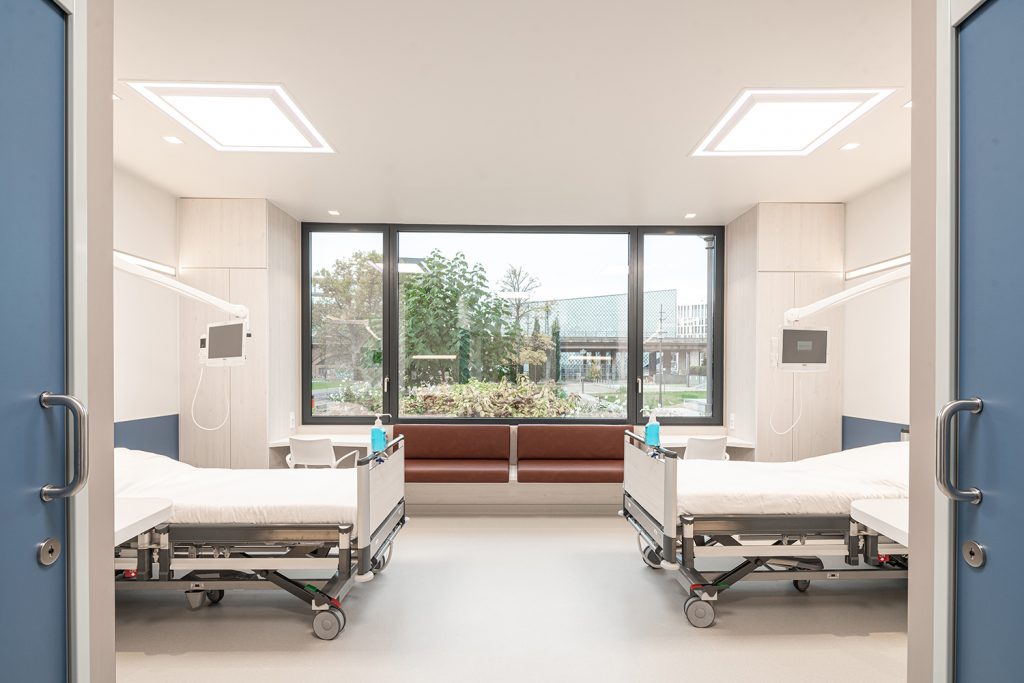
In the latest episode of the science podcast “Forsch!” by Braunschweiger Zeitung and ForschungRegion Braunschweig, Louisa Larsen and Dr. Jeremias Othman from the House of Science explore the patient room of the future. In conversation with experts, they learn, among other things, how the patient room is intended to help prevent infections and whether there will be robots in hospitals in the future.
Three Partners and Industry
The demonstrator for future hospital rooms, located on Naumburgstraße in Braunschweig, is a joint project of the Institute for Constructive Design, Industrial and Healthcare Construction (IKE) at TU Braunschweig, the Fraunhofer Institute for Surface Engineering and Thin Films IST, and Städtisches Klinikum Braunschweig. Additionally, there are 19 partner companies from industry. The prototype of the patient room was developed in the KARMIN project and exhibited in Berlin in 2020 on the Charité campus during the World Health Summit. The walk-in model has now been transferred to a new application-oriented research and study laboratory. Together, the consortium is working and researching how to shape the future use of resources for the benefit of patients and nursing staff.
Dr. Thomas Bartkiewicz, Medical Director at SKBs, describes the motivation behind the project: “With 600,000 infections and 15,000 people dying from them, even one death is too many.” Therefore, insights gained and model solutions developed are intended to be implemented nationwide and internationally from Braunschweig.
Translational Research Instead of Basic Research
Under the motto ‘From Bench to Bedside and Back,’ the central question is how the patient room will change in the future due to new developments in medicine and hygiene, societal demands, and advances in architecture, construction, and materials science. Professor Dr. Hamid Hossain, Chief Physician and Hospital Hygienist, Institute for Microbiology, Infectiology, Laboratory Medicine and Hospital Hygiene (MILKy), explains that the patient room in this form offers a pragmatic solution that meets the demands of everyday hospital life. Architecture and surfaces provide optimal conditions for conducting field trials and reintroducing the results into clinical practice.
Pragmatic, but There’s Still a Bit of Science Fiction
Dr. Wolfgang Sunder, Head of Research for Healthcare Construction at IKE, has already compiled a dozen tips to help prevent infections. These include the accessibility of disinfectant dispensers, regular hand disinfection, and seamless surfaces in wet cells. In addition to these pragmatic approaches, innovations are also being introduced:
Even if the surfaces in the room do not glow like northern lights to indicate infections, plasma, another state of matter alongside solid, gas, and liquid, can be used cost-effectively to disinfect surfaces. Additionally, ozone, diamonds, and automated cleaning systems are used for surface cleaning. “Even if we are not yet there, automated cleaning systems in the form of robots are of research interest,” says Dr. Kristina Lachmann, Group Leader for Medical Technology and Pharmaceutical Systems at the Fraunhofer Institute for Surface Engineering and Thin Films IST.
Interested individuals can visit the patient room during an open day. This will take place on Tuesday, September 6, 2022, from 4:00 PM to 7:00 PM at Städtisches Klinikum Braunschweig, Naumburgstraße 2a, 38124 Braunschweig.
Related Links:
Karmin – Patient Room of the Future, Technische Universität Braunschweig, Fraunhofer Institute for Surface Engineering and Thin Films IST, Städtisches Klinikum Braunschweig
The podcast “Forsch! – Science in Conversation” is a cooperation between ForschungRegion Braunschweig and Braunschweiger Zeitung. The moderators from ForschungRegion and Braunschweiger Zeitung speak with regional stakeholders about their research, their personal stories – and about current social, political, and ethical questions and debates.
Listen directly here or stream on Spotify, Apple Podcasts or Deezer.